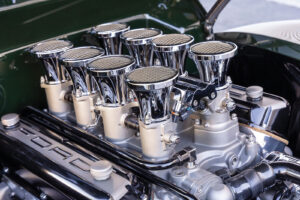
LS ITB Intake: Individual Throttle Bodies for LS1, LS3, and LS7 Builds
LS ITB intake systems replace the single factory throttle body and intake manifold with individual throttle bodies on each intake runner, giving each cylinder its own dedicated airflow path and delivering measurable gains in throttle response, top-end power, and induction sound that no factory LS setup can match. For LS1, LS3, and LS7 builds where peak performance and visual presence both matter, individual throttle bodies represent the most significant induction upgrade available on the platform.
Why LS Engines Respond So Well to Individual Throttle Bodies
The LS engine family was engineered from the outset with high-flow cylinder heads and efficient intake port geometry. This is exactly the architecture that benefits most from individual runner induction. When each cylinder draws air through its own throttle plate and runner rather than sharing a plenum with seven other cylinders, the engine responds more directly to throttle input, ram-air effects in the individual runners become usable at higher RPM, and the intake charge no longer has to compete for the plenum’s available volume under hard acceleration.
The factory LS intake manifold is well-engineered for its intended purpose: broad torque across a wide RPM range in a street car or truck. But it has real limitations for performance-focused builds. The common plenum design means that cylinder-to-cylinder fuel distribution depends on injector placement and manifold geometry rather than individual metering. At high RPM, the plenum volume acts as a buffer that smooths out the sharp pressure pulses that individual runners can exploit for power.
Individual throttle bodies address both constraints directly. Each runner’s length and diameter can be tuned for the specific RPM range the build targets, and each cylinder gets equal, isolated airflow regardless of manifold pressure dynamics.
LS1 ITB Builds: 5.7L Platform Considerations
The LS1 is a 5.7-liter engine, and its intake port size and flow characteristics are well-matched to 48mm to 52mm individual throttle bodies for most performance applications. Smaller throttle body bores maintain intake velocity at lower RPM and preserve streetable throttle response. For track-only or high-RPM LS1 builds, 55mm units can be used, but they typically give up some low-speed drivability in exchange for marginal top-end gains that only show up above 6,500 RPM.
LS1 builds running ITBs almost universally use a standalone ECU or a reflashed OEM ECU with custom MAF delete tuning. The factory LS1 PCM was designed around a mass airflow sensor and a single throttle body, neither of which exists in an ITB setup. Alpha-N fueling strategy, which bases fuel delivery on throttle position and RPM rather than airflow measurement, is the standard approach and requires a skilled tuner familiar with the platform.
LS3 ITB Builds: Higher Flow, Higher Ceiling
The LS3 displaces 6.2 liters and flows significantly more air than the LS1 through larger intake ports and improved head casting. This makes the LS3 one of the best LS candidates for individual throttle body induction because the engine’s airflow ceiling is high enough to reward the individual runner design across a broader RPM range than the smaller displacement LS1.
Throttle body sizing for LS3 ITB applications typically ranges from 52mm to 58mm per cylinder depending on power target and intended use. Street-driven LS3 restomod builds in the 450 to 500 HP range are well served by 52mm to 55mm units. Race and track builds targeting 550 HP and above can support 58mm units without sacrificing meaningful throttle feel on the street, particularly when runner length is optimized for the target RPM band.
The LS3’s strong low-end torque character also means that an ITB setup on this engine is more streetable than on some other platforms at equivalent throttle body sizes, because the engine has enough cylinder pressure at low RPM to maintain reasonable idle and off-idle behavior even with the aggressive intake configuration.
LS7 ITB Builds: The Factory High-RPM Platform
The LS7 is the most naturally suited LS engine for individual throttle body induction. At 7.0 liters, with titanium intake valves, dry-sump lubrication, and a factory redline of 7,100 RPM, the LS7 was engineered for exactly the kind of high-RPM breathing that ITB systems optimize for. The engine’s large intake ports and high-velocity head design respond strongly to individual runner tuning.
LS7 ITB applications commonly use 58mm to 62mm throttle bodies. The larger displacement means each cylinder is consuming more air per cycle, and undersizing the throttle bodies on an LS7 is a more common mistake than oversizing. A 500 HP LS7 build using 50mm ITBs will leave measurable power on the table above 5,500 RPM compared to a correctly sized 58mm setup.
For a full range of individual throttle body components suited to LS builds, Borla Induction’s throttle body lineup covers the sizing and configurations most commonly used across the LS1, LS3, and LS7 platform variants.
Throttle Body Sizing Reference for LS ITB Builds
Engine
Displacement
Street Build (TB Size)
Track / Race Build (TB Size)
LS1
5.7L
48mm to 52mm
52mm to 55mm
LS3
6.2L
52mm to 55mm
55mm to 58mm
LS7
7.0L
55mm to 58mm
58mm to 62mm
ECU and Tuning Requirements for LS ITB Systems
Tuning is the most critical element of any LS ITB build and the area where the most mistakes are made. The factory LS PCM was designed around a MAF sensor and a single throttle body. Neither of these exists in an ITB setup, which means the OEM fuel strategy cannot be used without significant modification.
Most LS ITB builds use one of three tuning approaches. The first is a fully standalone ECU such as a Haltech, MoTeC, or AEM Infinity unit, which offers complete control over fueling, ignition, and all auxiliary outputs but requires a full wiring harness build and an experienced calibrator. The second is a reflashed OEM PCM with MAF delete and alpha-N fueling enabled, which is a more budget-conscious path but limits flexibility compared to a standalone. The third approach, increasingly common in restomod builds, uses a modern self-learning ECU that can adapt to the ITB’s airflow characteristics during the initial drive calibration cycle, reducing the number of dyno sessions required to achieve a streetable base tune.
Regardless of ECU choice, idle calibration on an LS ITB setup requires more time and expertise than a standard EFI tune. Eight throttle plates that are not perfectly synchronized will produce a rough or hunting idle. Throttle body synchronization, idle air control strategy, and transition enrichment from idle to part-throttle are the three areas that consume the most tuning time on most LS ITB builds.
For EFI components that complement an ITB setup, including injectors, fuel rails, and pressure regulators suited to LS platform builds, the Borla Induction EFI components section covers the supporting hardware needed to complete the system correctly.
Frequently Asked Questions
Do LS individual throttle bodies make more power than a single throttle body intake?
On a modified LS engine with supporting upgrades, yes, ITBs typically add 20 to 40 HP over a quality single throttle body intake on a build making 450 HP or more, with gains concentrated above 5,000 RPM. On a mild stock-cam LS with no other modifications, the gains are smaller, and the trade-off in idle quality and low-speed drivability may not be worthwhile. ITBs earn their place on builds where top-end airflow and throttle response are the priority.
Can I run LS individual throttle bodies on a street car?
Yes, with the right tuning. LS ITB setups on street cars require a skilled calibrator and typically more tuning time than a single throttle body conversion, but properly tuned LS ITB engines are entirely streetable, including in traffic. The LS3 and LS7 are particularly good candidates for street ITB use because their displacement and torque output make the engine less sensitive to the intake velocity losses that affect smaller engines at low RPM with large throttle bodies.
What intake manifold do I need for LS ITB conversion?
LS ITB systems replace the factory intake manifold entirely with individual runner stacks or a purpose-built ITB manifold. The factory LS intake is a common-plenum design that is not compatible with individual throttle bodies. Most LS ITB builds use either a billet or fabricated aluminum manifold with individual runners sized and tuned for the target RPM range, or a bell-stack design that mounts the throttle bodies directly on the head without a conventional manifold.
What fuel injectors do I need for an LS ITB build?
Most LS ITB builds use port-injection with one injector per cylinder. For a naturally aspirated LS3 targeting 500 HP, injectors in the 42 to 48 lb/hr range at 80% duty cycle are appropriate. LS7 builds at similar power targets use 48 to 55 lb/hr injectors due to the larger displacement. Always calculate injector sizing based on your specific power target and BSFC estimate rather than using platform defaults, particularly if forced induction may be added later.