
EFI for SBC and BBC Engines: What Fits and What Fails
Key Takeaways
- Small Block Chevy (SBC) and Big Block Chevy (BBC) engines share some common features (like the 4150 carburetor flange) but require specific attention to intake manifold height, port shape, and accessory drive clearance when upgrading to fuel injection systems.
- The most critical compatibility check is ensuring the chosen throttle body injection (TBI) unit clears the hood and any existing accessories.
- Modern, engineered kits, such as those from Borla, simplify the conversion by offering direct bolt-on solutions that minimize installation complexity and guarantee proper performance intake manifolds compatibility.
As a specialist working daily with high-performance vehicles, few engines define the American muscle landscape like the Small Block Chevy (SBC) and the Big Block Chevy (BBC). They are the backbone of the aftermarket industry. The shift from classic carburetion to modern fuel injection systems is the most significant performance upgrade an owner can make, but it’s not always a simple bolt-on affair.
Choosing an EFI kit for a Chevrolet V8 involves more than just selecting a brand. It requires a meticulous check of your engine’s current configuration to ensure the TBI unit and supporting components fit correctly and deliver peak performance. Here is your expert guide to SBC and BBC EFI compatibility.
SBC vs. BBC EFI Compatibility: The Critical Checks
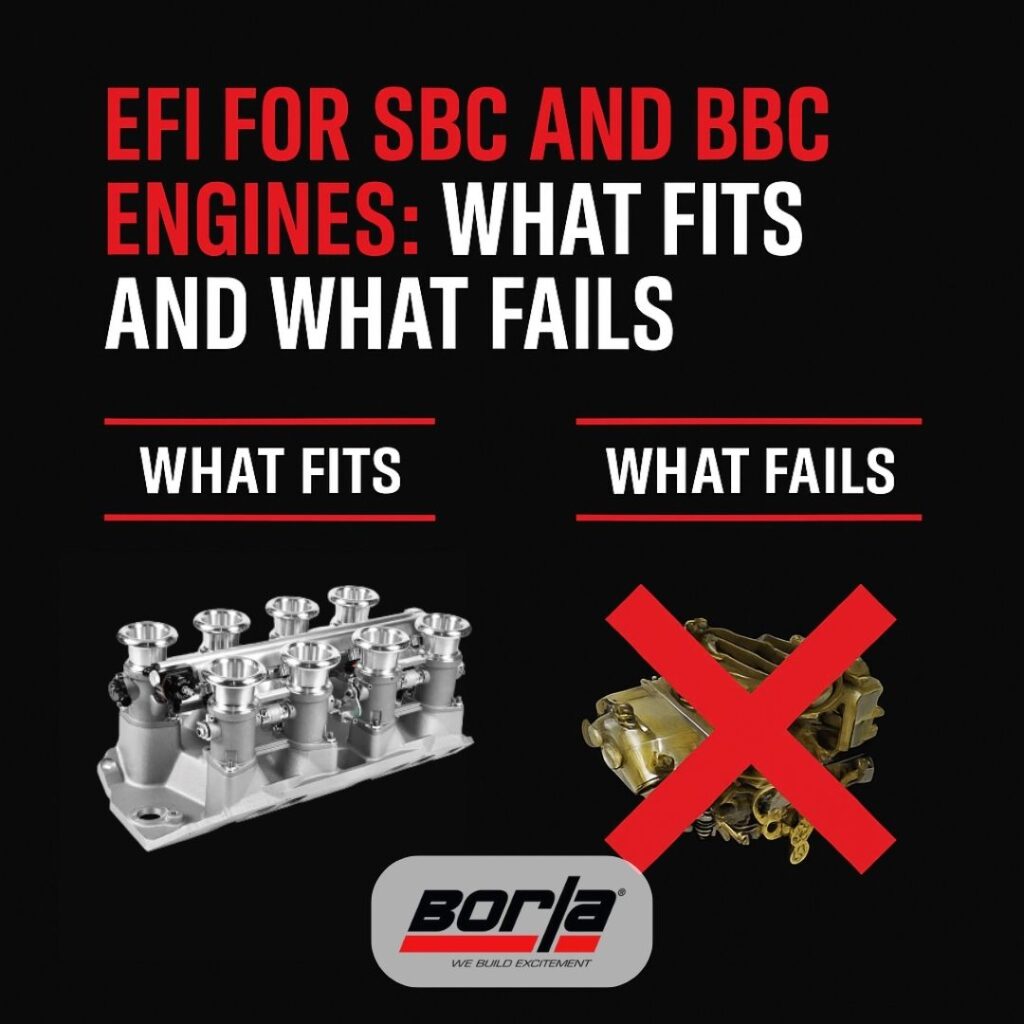
While both SBC and BBC use a standard 4-bolt carburetor flange (commonly the Holley 4150 pattern) on many performance intake manifolds, the surrounding dimensions and inherent engine design differences create unique fitment challenges.
1. Intake Height and Hood Clearance
This is the most common failure point for any TBI installation. Performance intake manifolds—especially high-rise, dual-plane, or single-plane race manifolds—are significantly taller than factory pieces.
- The Problem: The addition of a TBI unit, which can be taller than a traditional carburetor due to integrated fuel rails, sensors, and often an air cleaner mounting ring, may cause the air cleaner or the TBI unit itself to hit the underside of your hood, particularly in low-profile classic cars (e.g., C2 Corvettes or early Camaros).
- The Check: Measure the distance from the flange surface to the underside of the hood. Compare this to the dimensions of the specific EFI unit you plan to purchase. Don’t forget to account for the thickness of the air filter housing.
2. Port Shape and Gasket Matching
While a TBI system is not as sensitive to port shape as a multi-port fuel injection system, compatibility with the performance intake manifold is crucial for efficiency and power.
- SBC Considerations: Older SBC heads (e.g., pre-Vortec) have different port shapes and locations than later versions. Ensure your manifold gasket matches your head ports, and that the TBI is correctly sized for the manifold’s flow capacity.
- BBC Considerations: BBC engines use two distinct port designs: Oval Port and Rectangle Port (sometimes called Square Port). Rectangle ports are typically for high-RPM, high-horsepower applications. You must ensure your intake manifold is designed for your specific head type. While the TBI unit itself sits on the universal flange, using a manifold that doesn’t match your ports is a recipe for poor airflow and reduced power.
3. Throttle Body Spacing and Accessory Clearance
The physical size of the throttle body, especially if opting for a two-piece or multi-port style setup, must be checked against engine accessories.
- SBC/BBC: The front of the throttle body must clear the serpentine accessory drive system, including the alternator bracket, power steering pump, and thermostat housing. Large, forward-facing fuel lines on some kits can also interfere with brackets.
- Recommendation: Look for systems designed with a compact footprint and adjustable clocking for the throttle body or fuel lines to avoid tight spots.
Borla Kit Options That Simplify Installation
The complexity of pairing EFI components with a classic SBC or BBC engine is why Borla developed kits that prioritize direct fitment and self-tuning capability. Our goal is to eliminate the guesswork involved in upgrading to modern fuel injection systems.
Borla’s throttle body injection kits are designed around the industry-standard 4150 flange, allowing for a seamless transition from most existing carbureted manifolds.
Engineered Compatibility Features:
- Compact TBI Unit: Borla’s throttle bodies are engineered for a low-profile fit, maximizing hood clearance even on cars with high-rise manifolds.
- Integrated Sensors: The systems come with necessary sensors (like the Coolant Temperature Sensor and Wideband O2 Sensor) that are engineered to integrate cleanly into the engine bay, reducing wiring clutter and potential failure points.
- Chevy-Specific Solutions: By focusing our product line on common platforms like the SBC and BBC, we ensure the included software, base maps, and component configurations are optimized out-of-the-box for these legendary powerplants.
You can view our dedicated Chevy throttle body injection options here.
Beyond the Throttle Body: EFI Components for Success
A successful EFI conversion on your SBC or BBC is only as good as its supporting parts. The TBI unit handles the delivery, but the fuel system and ignition system handle the heavy lifting.
- Fuel System: You must convert to a high-pressure, return-style fuel system (typically 40–60 PSI). This requires a new electric fuel pump, high-pressure line, and a regulator. Trying to adapt a low-pressure carbureted fuel line will cause catastrophic failure.
- Ignition: While some systems allow control of timing, the EFI system requires a reliable electronic ignition signal (e.g., an electronic distributor) to function correctly.
Before purchasing any kit, review the necessary EFI Components to ensure you have a complete plan for the conversion, not just the throttle body itself.
We build excitement, upgrade your big or small block the smart way. If you have specific fitment questions regarding a BBC with a tall intake or an SBC with unique accessory brackets, don’t guess.
Contact our technical team for expert guidance.
For detailed troubleshooting or installation help, visit our Support section.